
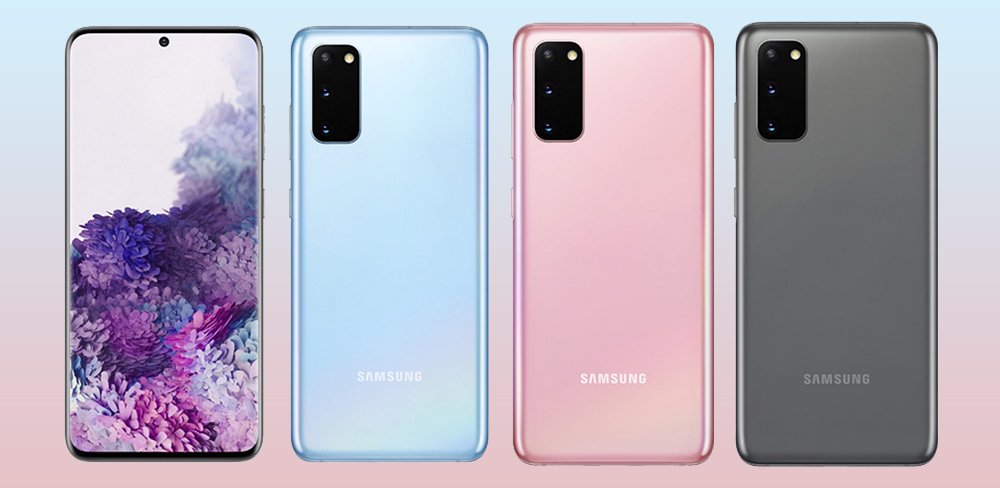
Updated 24 March 2020: Samsung has taken a big leap forward with the name of its latest flagship smartphone, going from the Galaxy S10 to the S20. The branding for the three models in the lineup, going from the S10e, S10 and S10+ to S20, S20+ and S20 Ultra. Here’s what’s different about the Samsung Galaxy S20 and the Samsung Galaxy S20+ to help you decide which one to go for.
Samsung Galaxy S20 vs Galaxy S20+ Comparison Chart
| Model | Samsung Galaxy S20 | Samsung Galaxy S20+ |
 |  | |
| Price | Check Price | Check Price |
| Display | 120 Hz Infinity-O Dynamic AMOLED Display | 120 Hz Infinity-O Dynamic AMOLED Display |
| Screen Size | 6.2″ | 6.7″ |
| Resolution | 3200 x 1440 pixels | 3200 x 1440 pixels |
| Pixel Density | 563 ppi | 525 ppi |
| Dimensions | 152 x 68 x 7.9 mm | 162 x 74 x 7.8 mm |
| Weight | 164 g | 188 g |
| CPU | Exynos 990 / Qualcomm Snapdragon 865 | Exynos 990 / Qualcomm Snapdragon 865 |
| RAM | 12GB | 12GB |
| Storage | 128GB, 256GB | 128GB, 256GB |
| Rear Cameras | 12MP Wide, 64MP Telephoto, 12MP Ultra-Wide | 12MP Wide, 64MP Telephoto, 12MP Ultra-Wide, ToF Camera |
| Zoom | Up to 30X Digital Zoom | Up to 30X Digital Zoom |
| Front Cameras | 10MP IMX 374 | 10MP IMX 374 |
| Video | Back: up to 8K 30 fps Front: up to 4K 60 fps | Back: up to 8K 30 fps Front: up to 4K 60 fps |
| Battery | 4000mAh | 4500mAh |
| Water Resistance | IP68 | IP68 |
| Android Version | Android 10.0 with One UI 2.0 | Android 10.0 with One UI 2.0 |
| MicroSD | Yes | Yes |
| 3.5 mm | No | No |
| Colors | Cosmic Gray, Cloud Blue, Cloud Pink | Cosmic Black, Cosmic Gray, Cloud Blue |
Design
The Samsung Galaxy S20+ is bigger than the Galaxy S20.

Both new Galaxy S20 models will be rocking pretty much the same overall design as the previous generation, with a few extra trimmings here and there. As expected, the bezels around the display has gotten even thinner compared to those of the Galaxy S10. Samsung also moved the punch hole for the front camera from the corner to the center, and it’s smaller than ever. They did the reverse at the back though, moving the horizontally aligned camera array to the upper left corner.
All three models in the S20 lineup vary in size, with the Galaxy S20 being the smallest. It would be difficult to tell each model apart without placing them side by side, as they look virtually identical. That is, until you take a look at the size and shape of the camera hump. The panel housing the sensors is wider on the S20+ and even wider still on the S20 Ultra.
You can get the Galaxy S20 in Cosmic Gray, Cloud Blue, and Cloud Pink, and the S20+ in Cosmic Black, Cosmic Gray, and Cloud Blue. All models have an IP68 rating which makes them water-resistant up to 5 meters. It’s an improvement over the 1.5 meters of the latest S10 and Note10 phones.
Display
The Samsung Galaxy S20+ has a larger display but smaller pixel density than the Galaxy S20.

Headlining the display updates is the stunning 120 Hz refresh rate of the Galaxy S20 screens, which will put them on par with the slickest Android flagships. This will make the phone feel more responsive than previous generations, and significantly improve video game graphics as well. Running it at 120 Hz will lower the default resolution of 3200 x 1440 pixels to 2400 x 1080 FHD+, though it doesn’t impact overall quality too much.
With a 6.2-inch screen, the Galaxy S20 has a bigger display than most current flagships like the iPhone 11. At its highest resolution this gives it a significantly higher pixel density, too, of 563 pixels per inch. In comparison, this is a bit lower on the larger 6.7-inch screen of the Galaxy S20+, which still jams 525 pixels per inch. Expect impressive clarity and sharpness from either device.
Performance
The Samsung Galaxy S20 and S20+ have the same processing power.

As in previous releases, Samsung uses different chipset brands for the Galaxy phones depending on region. All Samsung Galaxy S20 phones released in North America will be equipped with a Qualcomm Snapdragon 865, while the Exynos 990 will power units sold everywhere else. There are minor performance variations between the two but they’re pretty similar overall. Both S20 and S20+ models will also have the same 12GB RAM.
Based on benchmark scores for a reference device with the new Snapdragon 865 tested last year, it posted very close scores to the currently fastest smartphone, the iPhone 11 Pro Max. This will also mean that it’s significantly faster than the latest release from Samsung, the Note 10 Plus. The Galaxy S20 smartphones will run on Android 10 Pie with the One UI 2.0. One new feature that’s bound to see a lot of use is Quick Share, which is essentially AirDrop for Galaxy devices.
Cameras
The Samsung Galaxy S20+ has a ToF camera in addition to those on the Galaxy S20.

Samsung aimed at improving the Galaxy’s cameras the most with the new S20 series. In addition to moving the camera array to the top left, the Korean giant also gave the Galaxy S20 new tools. Joining the 12MP main Wide and 12MP Ultra-wide sensors is a 64MP Telephoto lens capable of up to 5x optical zoom. What sets the bigger S20+ from the S20 is the added Time of Flight (ToF) camera, which enhances background blur and depth of images while also enabling more creative features.
Up front is the same 10MP Sony IMX 374 that can be found on the Galaxy S10 and Note 10. It can record up to 4K videos at 60 frames per second, while the rear cameras is capable of 8K resolution at 30 fps. All S20 phones will use the same software and have the same new features.
Some of the new photography features include Single Take Photo, which grabs photos and clips as you pan your phone around a scene, and QuickTake, which takes a snapshot from 3 sensors at once and lets you choose which to keep. Samsung also improved its Bright Night mode, putting it on par with the latest from Apple and Google.
Battery and Other Features
The Samsung Galaxy S20+ has a bigger battery than the Galaxy S20.

A bigger display needs a bigger battery, and that’s certainly the case for the S20 and S20+. The former has 4000 mAh capacity while the latter has 4500 mAh. These numbers are a boost compared to the current crop of Galaxy phones, though it remains to be seen how they convert to actual hours of usage.
Fans of the 3.5 mm jack will lament its absence from any of the S20 models. It’s not a surprise given that the Note 10 has already left it out. However, the good news is that a MicroSD slot is likely to be retained, which will provide a nice cushion for the 128GB and 256GB internal storage options.
You can choose whether to get your Galaxy S20 with a Protective Standing Cover, Clear View Cover and LED View Cover on release. Actual colors for these covers is still not definite though, but it does seem like the LED cover will actually display notifications on them which is pretty exciting.
Verdict
The Samsung Galaxy S20 offers better value than the Galaxy S20+.
Samsung Galaxy S20

Samsung Galaxy S20+

With a big $200 price difference between them, the Samsung Galaxy S20 is simply better value since you get the same performance, smooth display along with easier portability. This is even more the case if you’re not particularly after the ToF camera sensor of the larger S20 models. As of writing, the Galaxy S20 is even more affordable, as Samsung is offering a $200 price cut on it as well as the S20+.
As such, if you feel that the bigger screen, additional camera and slightly larger battery capacity of the Samsung Galaxy S20+ is worth it, now’s the best time to grab it. It’s essentially a free upgrade of the S20 with the current price cut it’s being offered at on Amazon.