

GermGuardian and Blueair are some of the best in the air purifying business. Both carry air purifiers that can effectively clean the air, but while they’re similar in that regard, they use distinct technologies to get the job done. In other words, they’re both reliable, but you won’t exactly get the same experience from each one.
In this Blueair and GermGuardian air purifier comparison, we’re going to outline a couple of important points that make one brand different from the other. We’ll also take a closer look at their highly rated models, namely the Blueair Blue Pure 411 and GermGuardian AC4825.
GermGuardian vs Blueair Comparison Chart
| Top-Rated Models | GermGuardian AC4825 | Blueair Blue Pure 411 |
| Amazon product | Amazon product | |
| Price | Amazon product | Amazon product |
| Capacity | 153 sq ft | 161 sq ft |
| Filtration | HEPA filter, charcoal filter, UV-C light, TIO2 treatment | Pre-filter (washable), particle and carbon filter, main filter, HEPASilent technology |
| Filter Replacement Indicator | Yes | Yes |
| Air Intake | Front | 360 degrees |
| Fan Speeds | 3 | 3 |
| CADR Rating | Pollen: 125 cfm Dust: 118 cfm Smoke: 99 cfm | Pollen: 120 cfm Dust: 120 cfm Smoke: 105 cfm |
| Minimum Noise Level | Not stated, but estimated to be around 40 dB | 17 dB |
| Power | 55W | 1.5W to 10W |
| Dimensions (H x W x D) | 21.5” x 6.75” x 10.25” | 16.7″ x 8″ x 8” |
| Weight | 8.55 lbs | 3.4 lbs |
Highlight Features
GermGuardian air purifiers’ main selling point is their UV-C bulbs, while Blueair models boast HEPASilent filtration technology for quiet and efficient operation.

Right off the bat, GermGuardian stands out because its air purifiers use UV-C light. For the uninitiated, it can help decrease bacteria, viruses, and mold spores in the air, typically working in conjunction with HEPA and charcoal filters.
Now there’s concern that GermGuardian air purifiers produce ozone, but according to the company, it complies with U.S. and Canadian safety standards. In particular, the AC4825 is Energy Star certified and is confirmed to produce 0.0 ppb (parts per billion) of ozone.
On the other hand, Blueair air purifiers set themselves apart from the pack with what the company calls HEPASilent filtration technology. Put simply, it uses electrostatic energy to get particles to stick to their filters. This doesn’t just make them more effective but also relatively more efficient and quieter compared to mechanical counterparts. That’s because they don’t need dense filters or that much air pressure.
Selection
Both GermGuardian and Blueair offer a ton of options.

GermGuardian has table top, tower, console, and smart air purifiers, all of which have its signature UV-C light technology. There are also bags filled with charcoal in the mix that can reduce moisture and eliminate odors. The point here is the company has just about any form factor to suit your needs.
Blueair has a different approach, categorizing its products based on technology and design. However, it’s still similar since its air purifiers come in a variety of shapes and sizes. Its selection includes the simple and lightweight Blue lineup and the tried-and-tested Classic. Then there’s the DustMagnet that draws inspiration from a Scandinavian theme, and the Pro that sports a minimalist look made for professional settings such as offices and studios.
Last but not least, the HealthProtect is Blueair’s most advanced air purifier. For one thing, it has voice controls and an accompanying app that can be used to control it. Not to mention that it works 24/7 in getting rid of bacteria and viruses, preventing their growth by closely monitoring rooms via its GermShield technology.
Recommended Models
The Blueair Blue Pure 411 runs more quietly and is more power efficient than the GermGuardian 4825.
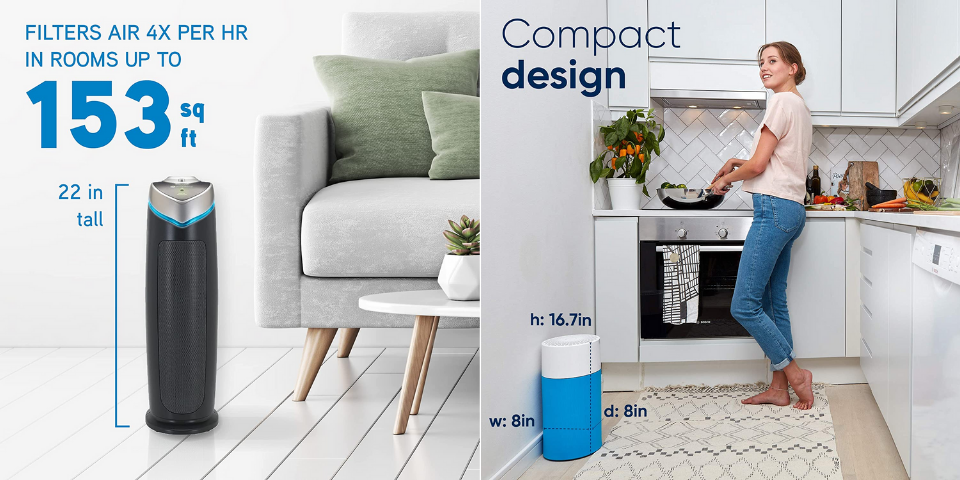
It isn’t surprising that the GermGuardian 4825 and Blueair Blue Pure 411 are two of the best-selling air purifiers in the market. For starters, they have an excellent price-to-performance ratio, meaning neither one breaks the bank yet offers plenty of features.
The 4825 can cover up to 153 sq ft and uses a filtration system composed of a HEPA filter, charcoal filter, UV-C light, and TIO2 treatment to decrease VOCs. It has a CADR rating of 125 cfm for pollen, 118 cfm for dust, and 99 cfm for smoke. Thing is, it only takes in air from the front, and it operates at 55W and an estimated minimum noise level of 40 dB, which can be pretty loud. It’s a tower type that measures 21.5” x 6.75” x 10.25” in height, width, and depth, respectively, and weighs 8.55 lbs.
Meanwhile, the Blue Pure 411 is suitable for rooms up to 161 sq ft and uses a washable pre-filter, particle and carbon filter, main filter, and HEPASilent technology with a 360-degree air intake. As for its CADR rating, it’s pegged at 120 cfm for pollen and dust and 105 cfm for smoke. Impressively, it only needs 1.5W or up to 10W and runs silently at 17 dB. It’s also compact with a height of 16.7 inches and a width and depth of 8 inches, as well as a weight of 3.4 lbs.
Both have three fan speeds, carbon filters for odor control, and a filter replacement indicator, but that’s about where their similarities end. The 4825’s advantages include a higher cfm for pollen, a slightly lower price tag, and a UV-C bulb—that is, if that’s what you’re after. Arguably, the Blue Pure 411 has the edge because of its larger capacity and 360-degree air inlet. In addition, its HEPASilent technology lets it trap particles as small as 0.1 microns, but besides that, it also made a lower noise level and power consumption possible because it needs less air pressure by design. Moreover, it’s smaller and lighter, so it’s easier to move from one room to another.
Click here for our Levoit vs Blueair vs Bissell air purifier comparison.
Verdict
GermGuardian and Blueair are as reliable as they can get, and each one offers unique benefits.
You can’t go wrong with either GermGuardian or Blueair, as evidenced by the GermGuardian 4825 and Blueair Blue Pure 411. Each brand has a ton of models for just about any situation, and they’re all as effective as any air purifier worth its salt.
But when it comes to our recommended models, we’d go with the Blue Pure 411. After all, it operates more silently and requires less power, and it can catch 0.1-micron particles as opposed to 0.3-micron particles that traditional true HEPA filters can typically trap. However, if your heart’s set on getting a GermGuardian or simply a UV light air purifier, the 4825 can go a long way.
FAQs
Yes, the company makes reliable and efficient air purifiers, such as the GermGuardian AC4825. It features a UV-C bulb to effectively reduce bacteria and viruses in the air, and it has a respectable CADR rating for its price.
Yes, GermGuardian air purifiers’ UV-C bulbs don’t produce ozone, meeting U.S. and Canadian safety standards.
Yes, the Blueair Blue Pure 411 gives a lot of bang for your buck. It has a compact form factor, runs quietly without consuming too much power, and features HEPASilent technology, a washable pre-filter, a particle and carbon filter, and a main filter.
Blueair’s HEPASilent filtration technology can capture 0.1-micron particles, while HEPA filters usually trap 0.3-micron particles.